
If you saw “ASL” in a text, comment, or DM, the meaning may not be obvious at first glance. This three-letter abbreviation has more than one common use, and the surrounding sentence usually tells you which one fits.
In modern texting, “asl” often means “as hell” and adds emphasis to a word. For example, “That movie was funny asl” means the movie was extremely funny. In older internet chat, “ASL?” meant “Age, Sex, Location?” and asked for basic information about someone. ASL can also mean American Sign Language in conversations about language, education, or the Deaf community.
Quick Answer
ASL can mean three main things in online communication:
| ASL meaning | Common context | Example |
|---|---|---|
| As hell | Modern texting and social media slang | “That was funny asl.” |
| Age, Sex, Location | Older online chat slang | “ASL?” |
| American Sign Language | Language, education, and accessibility | “I’m learning ASL.” |
The quickest way to identify the meaning is to examine how ASL appears in the sentence.
If it follows an adjective, such as “tired asl” or “cute asl,” it usually means “as hell.” If someone sends only “ASL?”, they may be asking for age, sex, and location. If the conversation involves signing or language classes, it likely means American Sign Language.
What Does ASL Meaning in Text & Chat?
In current texting slang, asl commonly means “as hell.” People use it as an intensifier to make an adjective or description stronger.
For example:
“I’m tired asl.”
This means:
“I’m extremely tired.”
However, ASL has an older internet meaning too. “ASL?” was traditionally used to ask someone’s age, sex, and location in online chatrooms. The abbreviation became associated with quick introductions among strangers online.
Simple Example
Compare these two messages:
“That game is hard asl.”
Here, asl = as hell.
“Hey, ASL?”
Here, ASL = age, sex, location.
The difference is easy once you look at the grammar and purpose of the message.
Quick Chat Examples
Here are some natural examples of modern asl:
- “That test was hard asl.”
- “I’m hungry asl.”
- “You’re funny asl 😂.”
- “It’s cold asl today.”
- “That outfit is cute asl.”
Older chat usage may look like:
- “ASL?”
- “Can I ask your ASL?”
- “Hey, what’s your ASL?”
Is It Safe to Answer an ASL Question Online?
You don’t have to share personal information just because someone asks “ASL?”
The traditional phrase requests details about your age, sex, and location. That can feel harmless in a casual chat, but strangers online don’t necessarily need those details.
If you’re uncomfortable, you can keep your answer broad or decline.
For example:
- “I’d rather not share personal details.”
- “I’m from the US.”
- “Let’s chat first.”
- “I don’t share my location online.”
Avoid giving strangers your home address, school, workplace, phone number, or exact location. A basic slang question doesn’t give someone a reason to know private information.
Why Does ASL Have So Many Different Meanings?
ASL comes from several different language communities. Internet users created shorthand to communicate quickly, while American Sign Language developed as a complete visual language.
The modern slang “asl” for “as hell” became common in casual online communication. The older “age, sex, location” abbreviation came from internet chat culture. Meanwhile, American Sign Language has nothing to do with either slang meaning.
This is why context matters more than the three letters themselves.
Think of ASL like a word with multiple doors. The sentence tells you which door to open.
Full Form, Stands For & Short Meaning of ASL
The traditional internet-chat full form of ASL is:
Age, Sex, Location
The modern slang form is:
As hell
Another major meaning is:
American Sign Language
Breakdown of the Full Form
| Letter | Traditional meaning |
|---|---|
| A | Age |
| S | Sex |
| L | Location |
An old-style chat exchange might look like this:
Person 1: “ASL?”
Person 2: “21/F/Chicago.”
This usage was particularly associated with early internet chatrooms and quick introductions.
Modern Short Meaning
In modern social media slang, asl usually means “as hell.”
It works much like:
- very
- really
- extremely
For example:
“That song is good asl.”
Meaning:
“That song is extremely good.”
Example of Modern Usage
- “I’m tired asl.”
- “That dog is cute asl.”
- “This weather is hot asl.”
- “The movie was scary asl.”
- “He was laughing asl.”
The abbreviation usually comes after the word it intensifies.
Important Note
Capitalization can provide a clue, but it isn’t a perfect rule.
ASL? often points toward “Age, Sex, Location?”
asl after an adjective often points toward “as hell.”
Still, users don’t always follow capitalization conventions. The sentence and conversation remain more reliable than uppercase or lowercase letters alone.
Internal Linking Suggestions
For a website covering texting slang, useful related internal links could include:
- LOL meaning in text
- BRB meaning in texting
- TBH meaning
- WYD meaning in chat
- SMH meaning
- FR meaning in text
- Lowkey meaning
- No cap meaning
These related pages can build a stronger topical cluster around internet slang and texting abbreviations.
Origin, History & First Known Use of ASL
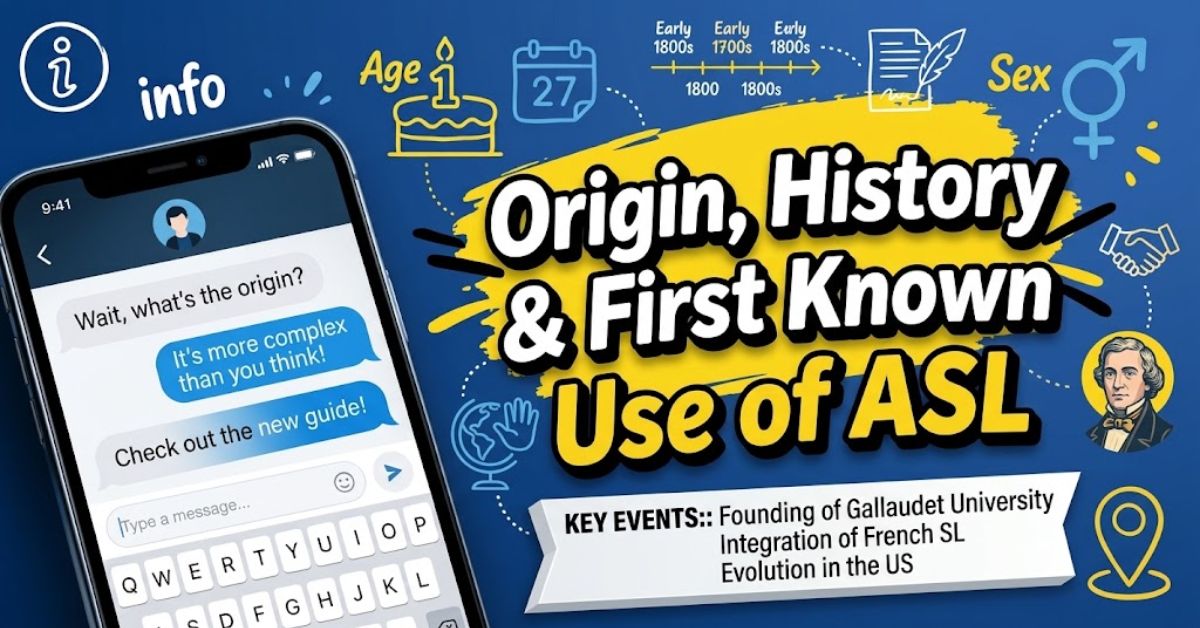
The older A/S/L abbreviation became closely associated with internet chatrooms during the early growth of online communication.
It was especially useful when strangers entered a chatroom and wanted to learn basic information about one another quickly. Historical references connect A/S/L with instant messaging and chatroom culture, particularly around the late 1990s and early 2000s.
There isn’t a reliable reason to assign one exact moment as the “first use.” Internet slang often spreads through communities before anyone formally records it.
Early Internet Culture
Older chatrooms moved quickly. Users didn’t want to type three complete questions every time someone new joined.
So instead of:
“What’s your age? What’s your sex? Where are you located?”
Someone could simply type:
“A/S/L?”
That shorthand became recognizable across online communities.
Why It Became Popular
ASL was popular because it was:
- short
- easy to type
- easy to understand
- useful for meeting strangers
- suited to fast-paced chatrooms
Early internet users relied heavily on abbreviations because typing was slower and conversations moved rapidly.
How the Meaning Changed
As chatroom culture changed, the traditional ASL question became less dominant.
Modern social media introduced a different use of asl, meaning “as hell.” This version works as an intensifier and appears in casual texts, comments, DMs, and social media conversations.
Interesting Fact
The same three letters can now point to two very different internet eras.
For older chat culture, ASL? may sound like a basic introduction. For a modern social media user, “funny asl” usually means “extremely funny.”
How People Use ASL in Daily Conversations
ASL appears differently depending on the sentence, platform, and people involved.
Traditional Use
The older meaning usually appears as a direct question.
Example
“Hey, ASL?”
The sender is likely asking for age, sex, and location.
This usage is less common in everyday mainstream texting than it once was, but people can still encounter it in online communities or conversations with older internet slang.
Modern Slang Use
The modern version usually appears after an adjective.
Examples
- “That food is spicy asl.”
- “I’m tired asl.”
- “She’s funny asl.”
- “This game is difficult asl.”
In each case, asl strengthens the word before it.
Why People Like Using It
Internet slang saves space and gives messages a casual tone.
Instead of writing:
“That movie was extremely funny.”
Someone might write:
“That movie was funny asl 😂.”
It feels quicker, more conversational, and more suited to informal digital communication.
Common Situations
You may encounter asl in:
- text messages
- group chats
- TikTok comments
- Instagram comments
- Snapchat messages
- gaming chats
- online forums
- casual DMs
Quick Bullet Examples
- “Cute asl.”
- “Cold asl outside.”
- “Tired asl rn.”
- “Funny asl 😂.”
- “ASL?”
Platform-Specific ASL Meaning
There isn’t a universal rule saying ASL has one fixed meaning on each platform.
The sentence structure matters more than the app itself. Current slang references commonly show “as hell” in social media usage, while “ASL?” can still carry the older meaning.
On WhatsApp, you may encounter either meaning.
Example
“ASL?”
Usually means “Age, Sex, Location?” in an introductory conversation.
“I’m tired asl.”
Means “I’m extremely tired.”
Instagram comments and DMs commonly use lowercase asl as an intensifier.
Examples
- “This outfit is cute asl.”
- “That photo is fire asl.”
- “I’m tired asl.”
TikTok
TikTok frequently uses asl in casual comments and captions.
Examples
- “Funny asl 😂.”
- “This is weird asl.”
- “That transition was clean asl.”
Still, don’t assume every TikTok use has the same definition. Context wins.
Snapchat
Snapchat can contain both traditional and modern meanings.
Examples
“ASL?”
Could mean age, sex, location.
“I’m bored asl.”
Means extremely bored.
Key Difference by Platform
| Platform | Likely modern use |
|---|---|
| Both meanings | |
| Often “as hell” | |
| TikTok | Often “as hell” |
| Snapchat | Both meanings |
These are usage patterns, not strict platform rules.
Different Meanings of ASL in Other Fields
ASL isn’t limited to internet slang. Dictionaries list several meanings for the abbreviation, including American Sign Language and above sea level, depending on the context.
American Sign Language
American Sign Language is a natural visual language used by many Deaf and hard-of-hearing people in the United States and parts of Canada.
It has its own grammar and structure. It isn’t simply English translated into hand signs.
Example
“She is learning ASL at college.”
Here, ASL clearly means American Sign Language.
ASL in Education
Schools and colleges may use ASL when discussing language courses, interpreting, accessibility, or Deaf studies.
Example
“I enrolled in an ASL class this semester.”
In this context, “as hell” obviously makes no sense.
ASL in Technology
In technical or scientific contexts, ASL can represent specialized terms. One notable non-slang meaning is above sea level, especially in measurements involving elevation.
For example:
“The town sits 1,500 feet ASL.”
Here, ASL means above sea level, not internet slang.
Why Context Matters
Context is the best ASL decoder.
Look at the word placement, punctuation, and subject of the conversation before deciding what the abbreviation means.
Compare These Examples
“ASL?”
Likely means Age, Sex, Location?
“That movie was scary asl.”
Means scary as hell.
“I’m taking an ASL course.”
Means American Sign Language.
“The village is 2,000 feet ASL.”
Means above sea level.
Four identical letters. Four completely different meanings.
Common Confusions, Mistakes & Wrong Interpretations
ASL causes confusion because internet slang and formal abbreviations overlap.
Mistake #1: Thinking It Always Means “Age, Sex, Location”
That was once a major internet use, but modern slang has expanded the abbreviation.
Today, “funny asl” almost certainly isn’t asking for someone’s age or location.
Example
“That video was funny asl.”
The meaning is “That video was extremely funny.”
Mistake #2: Confusing It With American Sign Language
ASL can refer to a real language rather than internet slang.
Example
“My sister is learning ASL.”
This means American Sign Language.
Mistake #3: Using It in Formal Conversations
The slang meaning of asl belongs mainly in casual communication.
Avoid it in:
- business emails
- academic papers
- formal reports
- professional applications
Write “very” or “extremely” instead when appropriate.
Mistake #4: Using It Without Context
A standalone “ASL” can leave the reader guessing.
Better Usage
Instead of:
“ASL”
Use enough context to make your meaning obvious:
“You look tired asl 😂.”
Or:
“ASL? I mean age, sex, location.”
Similar Terms, Alternatives & Related Slang
ASL belongs to the wider world of internet abbreviations.
Similar Slang Terms
| Slang | Meaning |
|---|---|
| LOL | Laugh out loud |
| TBH | To be honest |
| BRB | Be right back |
| WYD | What you doing? |
| SMH | Shaking my head |
| IMO | In my opinion |
| FR | For real |
| IDK | I don’t know |
Alternatives to “asl” (As Hell)
If you want to express strong emphasis without slang, you can use:
- very
- really
- extremely
- super
- incredibly
- seriously
For a casual slang alternative, people may also use hella depending on their style.
Examples
“That movie was funny asl.”
Similar versions include:
“That movie was really funny.”
“That movie was extremely funny.”
Related Internet Expressions
Modern internet slang often appears in combinations.
Related expressions include:
- lowkey
- highkey
- no cap
- bet
- FR
- literally
- deadass
Example
“That movie was good asl, no cap.”
Here, asl adds emphasis while no cap signals sincerity.
Examples of ASL in Real Chat Situations
Real examples make the difference easier to spot.
Traditional ASL Examples
- “Hey, ASL?”
- “What’s your ASL?”
- “ASL please?”
- “21/F/Texas.”
Modern Slang Examples
- “I’m tired asl.”
- “That food is good asl.”
- “This test was hard asl.”
- “You’re funny asl 😂.”
Gaming Chat Examples
- “This boss is hard asl.”
- “The lag is bad asl.”
- “That player is fast asl.”
TikTok Comment Examples
- “This is funny asl 😂.”
- “She’s cute asl.”
- “That transition is smooth asl.”
Snapchat Examples
- “I’m bored asl rn.”
- “This weather is cold asl.”
- “ASL? We should get to know each other.”
How to Reply When Someone Says ASL
Your response depends on the meaning.
If They Mean “Age, Sex, Location”
You can answer only what you’re comfortable sharing.
For example:
“I’m in Texas, but I don’t share my age online.”
Or:
“I’d rather not give personal details.”
There’s no requirement to provide private information.
If They Mean “As Hell”
You can respond naturally without explaining the slang.
Examples
- “For real 😂.”
- “Same!”
- “Facts.”
- “I know, right?”
- “Exactly 😭.”
Friendly Reply Ideas
If someone says:
“That movie was funny asl.”
You could reply:
“Right? I couldn’t stop laughing 😂.”
If someone says:
“I’m tired asl.”
You might say:
“Same. I need a nap.”
The best reply usually matches the casual tone.
Is ASL Still Popular? Trends & Online Usage
Yes, ASL remains recognizable in 2026, but its meaning depends heavily on the community and context.
Modern slang references continue to document asl = “as hell” in social media and texting. Older references still document A/S/L = age, sex, location as internet-chat slang.
Older Internet Users
People familiar with early chatrooms may immediately associate ASL with:
Age, Sex, Location
That interpretation remains understandable because of its long history in online communication.
Younger Social Media Users
Younger social media users are more likely to encounter asl as an intensifier.
Viral Examples
Common patterns include:
- “funny asl”
- “cute asl”
- “tired asl”
- “mad asl”
- “good asl”
- “weird asl”
The important pattern is simple:
adjective + asl = adjective + as hell
Why It Continues to Trend
ASL survives because internet slang is built for speed.
It’s short, expressive, and easy to add to a casual message. At the same time, its older meaning remains part of internet history.
That combination makes ASL unusual. One abbreviation connects early chatroom culture, modern social media slang, and American Sign Language.
FAQs About ASL Meaning in Text
What does ASL mean in texting?
In modern texting, asl often means “as hell” when it follows an adjective, while “ASL?” can mean “age, sex, location?” depending on context.
What does “asl” mean on TikTok?
On TikTok, lowercase asl commonly means “as hell” and adds emphasis, such as “funny asl” or “tired asl.”
Is ASL rude?
The slang itself isn’t necessarily rude, but “as hell” is informal and can sound inappropriate in professional or formal settings.
Does ASL mean American Sign Language too?
Yes. ASL commonly stands for American Sign Language when the conversation involves signing, language, Deaf communities, education, or accessibility.
Is ASL still used today?
Yes. The abbreviation still appears in modern texting and social media, while the older “age, sex, location” meaning remains recognizable in online chat contexts.
What is the difference between ASL and asl?
Capitalization can provide a clue, but it isn’t a strict rule. “asl” after an adjective often means “as hell,” while “ASL?” can mean “age, sex, location?” Context matters most.
Conclusion
The ASL meaning in text depends on how and where someone uses the abbreviation.
In modern social media slang, asl usually means “as hell” when it follows an adjective. “Funny asl” means extremely funny, while “tired asl” means extremely tired.
In older internet chat, ASL? meant “Age, Sex, Location?” It was a quick way to ask basic personal information from someone online.
ASL also commonly means American Sign Language, and in technical contexts it can refer to above sea level.
So, don’t judge the meaning from the three letters alone. Look at the sentence, punctuation, topic, and conversation around it. That small habit can solve most ASL-related confusion in seconds.

