
If you have seen IMAO meaning in a text, comment, gaming chat, or social media post, you may have wondered whether it means laughter, an opinion, or simply a typo.
The most established meaning of IMAO is “In My Arrogant Opinion.” It is an informal internet initialism used to introduce an opinion with exaggerated confidence, humor, irony, or sarcasm. It is closely related to IMO and IMHO, but the word “arrogant” deliberately changes the tone.
There is another reason IMAO can be confusing: in lowercase, imao looks very similar to lmao, and some people do use it accidentally as a typo for LMAO. Context usually reveals which meaning was intended.
What Does IMAO Meaning in Text & Chat?
IMAO means “In My Arrogant Opinion.” In casual texting, it signals that someone is about to share a personal view in a deliberately confident, cheeky, or exaggerated way.
It does not normally mean that the speaker is genuinely arrogant. The word “arrogant” is often part of the joke.
Quick Meaning of IMAO
IMAO = In My Arrogant Opinion
In simple English, it can mean:
- “This is my very confident opinion.”
- “I know I sound overly confident, but here is my take.”
- “This is my opinion, with a little humor.”
Collins lists IMAO as an abbreviation used in messaging and social media, while Dictionary.com describes it as an ironic or self-deprecating internet acronym.
Simple Chat Examples
- “IMAO, this is the best pizza in town.”
- “IMAO, that movie was seriously overrated.”
- “IMAO, cats are better than dogs.”
- “That outfit wins the whole week, IMAO.”
Why People Use IMAO
People use IMAO to make an opinion sound more playful and expressive. It can add:
- Humor
- Sarcasm
- Confidence
- Self-aware exaggeration
- A casual internet tone
The key is that IMAO frames an opinion, while LMAO expresses laughter.
Is IMAO Different From IMHO?
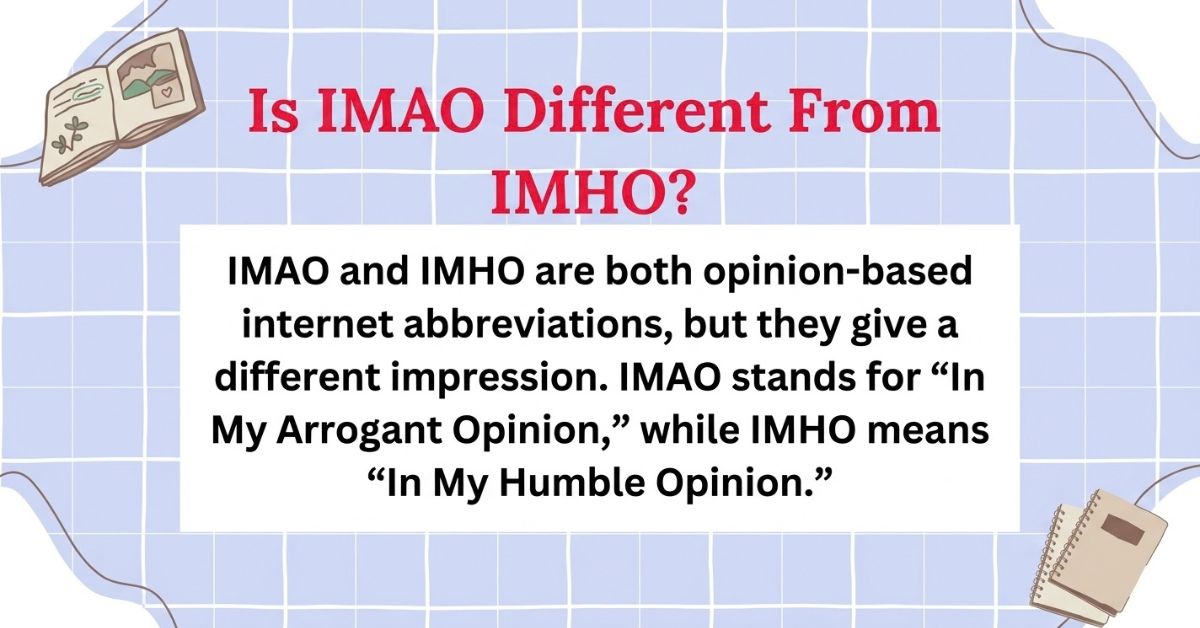
Yes. IMAO meaning “In My Arrogant Opinion,” while IMHO means “In My Humble Opinion.”
They both introduce opinions, but their tones move in opposite directions.
| Term | Full form | Typical tone |
|---|---|---|
| IMO | In My Opinion | Neutral |
| IMHO | In My Humble Opinion | Modest or polite |
| IMAO | In My Arrogant Opinion | Playful, bold, ironic |
| LMAO | Laughing My Ass Off | Strong laughter |
For example, “IMHO, this restaurant is good” sounds restrained. “IMAO, this is the greatest restaurant ever created” sounds deliberately overconfident.
IMAO is essentially a humorous twist on the older IMHO pattern.
Can IMAO Be Used in Formal Writing?

Generally, no.
IMAO is internet slang and works best in informal communication. Avoid it in:
- Academic assignments
- Business emails
- Job applications
- Official reports
- Professional proposals
- Formal letters
Instead, write “in my opinion,” “I believe,” or “in my view.”
These alternatives are clearer and appropriate for readers who may not know internet slang.
Full Form, Stands For & Short IMAO Meaning
The full form of IMAO is “In My Arrogant Opinion.”
The four letters represent:
I = In
M = My
A = Arrogant
O = Opinion
The phrase is intentionally playful because calling your own opinion “arrogant” creates a humorous contradiction.
Difference Between IMO and IMAO
IMO simply introduces a personal opinion.
IMAO introduces a personal opinion while adding exaggerated confidence or irony.
Example:
IMO: “This is the best game.”
IMAO: “IMAO, this is obviously the greatest game ever made.”
The second version sounds more dramatic and self-aware.
Short Meaning of IMAO
The shortest useful definition is:
IMAO meaning “In My Arrogant Opinion,” a humorous way to introduce a strong or confident personal opinion.
When It Sounds Friendly
IMAO usually sounds friendly when used with people who already understand your humor.
It fits well in:
- Friend chats
- Gaming conversations
- Meme comments
- Fandom discussions
- Casual social media posts
When to Be Careful
IMAO can sound genuinely arrogant if the surrounding message is aggressive or dismissive.
If you are criticizing someone’s serious opinion, using IMAO may make the message sound more hostile than intended. When clarity matters, simply write “in my opinion.”
Read More : BFFR Meaning in Text: Full Form, Uses, Examples & Social Media Trends (2026 Updated)
Origin, History & First Known Use of IMAO
The history of IMAO is older than many modern articles suggest.
Dictionary.com documents an early example from May 1989 in a Usenet discussion about the Grateful Dead. The writer used IMAO to mean “in my arrogant opinion” and even explained the abbreviation in the post. Dictionary.com notes that the expression appeared multiple times in Usenet discussions during 1989 and became more widespread in the early 1990s.
Early Internet Culture
IMAO developed from the same online culture that produced abbreviations such as IMO and IMHO.
Early internet users needed compact ways to express opinions, reactions, and tone in text-only discussions. IMAO provided a humorous alternative to the more modest IMHO.
Why It Became Popular
The expression worked because it was self-aware.
Instead of simply saying “this is my opinion,” a person could jokingly admit that the opinion sounded extremely confident.
That combination of opinion + irony + humor made IMAO useful in online debates and casual discussions.
Common Typing Confusion
IMAO also became confusing because it looks extremely similar to LMAO.
In lowercase, “imao” and “lmao” can be difficult to distinguish at a glance. Dictionary.com specifically notes that contemporary online usage can include IMAO as a misspelling of LMAO.
Modern Usage
Today, IMAO is recognized as an internet initialism, although it is less common than highly established abbreviations such as LOL, LMAO, IMO, and IMHO.
Its meaning has not disappeared, but readers increasingly rely on context to determine whether “imao” is intentional or simply a typo.
How People Use IMAO in Daily Conversations
IMAO meaning is most useful when someone wants to express an opinion without making the conversation feel overly serious.
Common Ways People Use IMAO
1. Sharing Opinions
“IMAO, this phone has the best camera.”
“IMAO, summer is better than winter.”
Here, IMAO signals a strong personal preference.
2. Making Jokes
“IMAO, pineapple absolutely belongs on pizza.”
“IMAO, my cooking deserves a Michelin star.”
The exaggerated confidence is what creates the humor.
3. Friendly Arguments
Two friends can use IMAO during a harmless debate.
Friend 1: “That team has the best defense.”
Friend 2: “IMAO, their defense is nowhere near the best.”
The abbreviation makes the disagreement feel more playful.
Tone Matters
IMAO can sound:
- Funny
- Sarcastic
- Confident
- Cheeky
- Self-aware
- Occasionally arrogant
The same four letters can feel friendly in one conversation and rude in another. Context, punctuation, emojis, and the relationship between the speakers all matter.
Best Places to Use It
Use IMAO in casual environments where slang is expected.
Good examples include:
- Text messages
- Group chats
- Gaming chats
- Social media comments
- Meme discussions
- Friendly online debates
Avoid it when the audience expects formal or professional language.
IMAO Meaning Across WhatsApp, Instagram, TikTok & Snapchat
The basic IMAO meaning does not change from one social platform to another. What changes is the context.
IMAO on WhatsApp
On WhatsApp, IMAO can appear in private messages or group chats.
Example:
“IMAO, you really thought that plan would work 😂”
It works especially well among friends who already understand each other’s humor.
IMAO on Instagram
On Instagram, you may see IMAO in comments, meme discussions, captions, or story replies.
Example:
“IMAO, this outfit deserves its own fashion show.”
IMAO on TikTok
TikTok comments often move quickly, so abbreviations can be used to make a reaction shorter.
Example:
“IMAO, this trend is getting ridiculous.”
However, IMAO is not a TikTok-specific abbreviation. It retains its broader internet slang meaning.
IMAO on Snapchat
Snapchat’s informal messaging style also makes short abbreviations useful.
Example:
“You actually sent that snap? IMAO 😭”
Social Media Trends
On social media, IMAO can appear alongside terms such as IMO, IMHO, NGL, TBH, LOL, LMAO, and FR.
Its exact frequency is difficult to measure reliably because slang is informal and spelling varies. The safer conclusion is that IMAO remains recognizable online but is not as universally common as LMAO or IMO.
Different Meanings of IMAO in Other Fields
The IMAO meaning depends on the field.
In ordinary English texting and social media, “In My Arrogant Opinion” is the relevant definition.
Possible Alternate Meanings
Some acronym databases and community sources list additional expansions, but these are far less established than the internet-slang meaning.
In another linguistic context, IMAO can also appear as an acronym related to monoamine oxidase inhibitors in Spanish terminology. This is unrelated to English texting slang.
Why Multiple Meanings Happen
Acronyms are reused because the same four letters can represent different phrases in different communities.
A medical abbreviation, technical abbreviation, and internet initialism can therefore share the same spelling.
Context Is Important
Ask yourself:
- Is this a casual conversation?
- Is the person expressing an opinion?
- Does the surrounding sentence involve laughter?
- Could the sender have meant LMAO?
These clues usually reveal the intended meaning.
Internet Slang Evolves Fast
Online language changes quickly. New expressions appear, old ones fade, and spelling mistakes sometimes become intentional slang.
That is why a dictionary definition and actual conversational context should be considered together.
Common Confusions, Mistakes & Wrong Interpretations
Most Common Confusion: IMAO vs LMAO
This is the biggest source of confusion.
IMAO = In My Arrogant Opinion
LMAO = Laughing My Ass Off
They perform completely different functions.
Example of Confusion
If someone writes:
“IMAO, that joke was hilarious 😂”
There are two possible readings. They could be using IMAO meaning intentionally, although the sentence sounds more naturally suited to LMAO. They may also simply have mistyped LMAO.
Why the Mistake Happens
The confusion happens because:
- Lowercase “l” and uppercase “I” can look similar.
- People type quickly.
- Autocorrect can interfere.
- LMAO is much more familiar.
- Some users intentionally use IMAO as a playful LMAO variation.
Community slang sources document both the intentional “In My Arrogant Opinion” meaning and typo-related uses.
Other Misunderstandings
Some unofficial expansions appear online, such as “In My Awesome Opinion.” These are not the standard English meaning.
For normal texting, In My Arrogant Opinion is the safest interpretation unless the surrounding context clearly indicates otherwise.
How to Avoid Confusion
If you are expressing an opinion, IMAO can work.
If you are laughing, use LMAO.
If you want zero ambiguity, write the phrase in full.
Helpful Tip
Look at the sentence rather than the four letters alone.
Opinion: “IMAO, that restaurant is overrated.”
Laughter: “That video was hilarious, LMAO.”
Context makes the difference.
Similar Terms, Alternatives & Related Slang
Popular Alternatives to IMAO
- IMO: In My Opinion
- IMHO: In My Humble Opinion
- NGL: Not Gonna Lie
- TBH: To Be Honest
- LMAO: Laughing My Ass Off
- LOL: Laugh Out Loud
When People Choose Other Terms
Someone may choose IMO when they want a neutral tone.
They may choose IMHO when they want to sound modest or respectful.
They may choose NGL or TBH when emphasizing honesty.
They choose IMAO when they want their opinion to have a more humorous or exaggerated edge.
Slang With Similar Tone
IMAO belongs to a larger group of expressions that help writers communicate attitude through short text.
For example, NGL can introduce an honest opinion, while TBH can make a statement sound direct.
Modern Slang Trends
Modern online conversations frequently combine older abbreviations with newer expressions.
A sentence might look like:
“IMAO, that movie was lowkey amazing.”
Here, the slang does more than shorten the message. It helps establish a casual digital voice.
Why Slang Keeps Changing
Internet slang changes because people constantly experiment with language.
Social media, memes, gaming communities, and younger online communities all contribute to new expressions. Some disappear quickly, while others become established parts of digital communication.
Read More : SPWM Meaning in Text: What It Stands For, Uses & Real Chat Examples (2026 Updated)
Examples of IMAO in Real Chat Situations
Casual Friend Chat
A: “Which burger place is better?”
B: “IMAO, the one downtown wins easily.”
Gaming Chat
A: “Is this new map good?”
B: “IMAO, it’s impossible to win on this map.”
Social Media Comments
“IMAO, this is the best look from the whole collection.”
Group Chat Examples
A: “I think we should watch a three-hour movie tonight.”
B: “IMAO, absolutely not 😂”
Funny Reactions
“IMAO, you really thought that was going to work.”
Quick Scanning Examples
- Opinion: “IMAO, this song is underrated.”
- Sarcasm: “IMAO, because breaking the app was definitely the goal.”
- Confidence: “IMAO, nobody makes better coffee than me.”
- Debate: “IMAO, the original version is still better.”
How to Reply When Someone Says IMAO
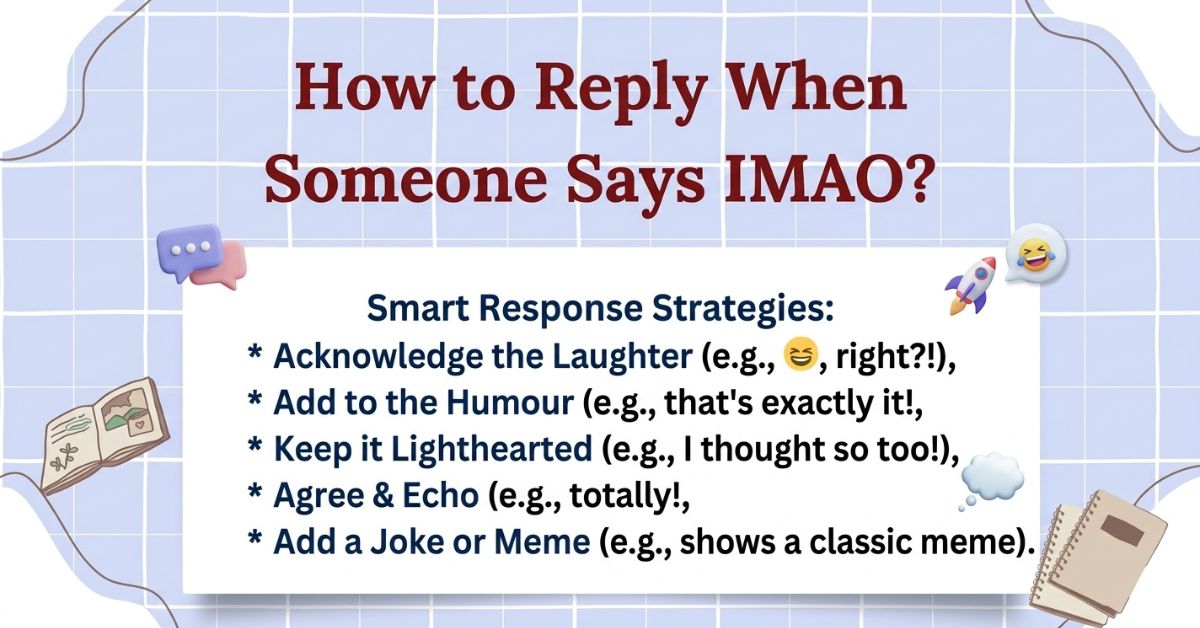
Your response should match the tone of the original message.
Friendly Replies
- “Haha, fair enough.”
- “That’s a bold opinion.”
- “You might actually be right.”
Playful Debate Replies
- “Hard disagree.”
- “Nah, my opinion wins.”
- “You’re seriously going with that take?”
Agreeing Responses
- “Exactly!”
- “Facts.”
- “I agree with you.”
- “Same here.”
When You Don’t Understand
If the message does not make sense, simply ask:
“Do you mean IMAO or LMAO?”
That is clearer than guessing.
Tips for Responding
Pay attention to the sentence around IMAO.
If it introduces an opinion, interpret it as In My Arrogant Opinion.
If it appears as a reaction to something funny, consider whether the sender intended LMAO.
Avoid Overusing It
Using slang occasionally keeps it natural.
If every sentence contains an abbreviation, the conversation can become harder to read, especially for people who are not familiar with internet slang.
Is IMAO Still Popular? Trends & Online Usage
Current Popularity
IMAO is still recognized in online communication, but it is not as dominant as common abbreviations such as IMO, LOL, or LMAO.
It can still appear in:
- Gaming communities
- Meme discussions
- Group chats
- Social media comments
- Online forums
Why It Still Exists
IMAO meaning has a simple purpose: it lets people signal that an opinion is intentionally confident or exaggerated.
That makes it useful when humor matters as much as the opinion itself.
Why It Is Less Common Today
One major problem is confusion with LMAO.
Because LMAO is much more widely recognized, some users may interpret “imao” as a typo rather than an intentional expression.
Slang Trends Keep Changing
Internet language never stays still.
Terms that were common years ago can become less familiar, while newer expressions can spread rapidly through social platforms and memes.
Will IMAO Disappear?
There is no reliable way to predict whether IMAO will disappear completely.
For now, it remains a recognized internet initialism, especially among people familiar with older online slang and opinion-based discussions.
FAQs About IMAO Meaning in Text
What does IMAO stand for in texting?
IMAO usually stands for “In My Arrogant Opinion.” It introduces a personal opinion with a playful, exaggerated, or confident tone.
Is IMAO the same as LMAO?
No. IMAO means “In My Arrogant Opinion,” while LMAO means “Laughing My Ass Off.” IMAO expresses an opinion; LMAO expresses laughter.
Is IMAO rude?
Not usually. It is often humorous or ironic, but it can sound arrogant if the surrounding message is aggressive or dismissive.
Where is IMAO commonly used?
It is mainly used in casual texts, group chats, gaming conversations, social media comments, memes, and online discussions.
Can I use IMAO in professional messages?
It is better to avoid IMAO in professional messages. Use “in my opinion,” “I believe,” or “in my view” instead.
Why do people confuse IMAO with LMAO?
The lowercase forms look very similar, and people often type quickly. Some users also intentionally use IMAO as a playful variation of LMAO.
Conclusion
The IMAO meaning in text is usually “In My Arrogant Opinion.” It is an informal internet initialism used to introduce a strong, confident, humorous, or deliberately exaggerated opinion.
IMAO is closely related to IMO and IMHO, but its tone is different. IMO is neutral, IMHO sounds modest, while IMAO meaning adds mock arrogance or irony.
The biggest source of confusion is LMAO, which means “Laughing My Ass Off.” If the sentence expresses an opinion, IMAO is likely intentional. If it is clearly reacting to something funny, the sender may have meant LMAO.
Historical evidence also shows that IMAO is not simply a recent social media invention. Dictionary.com documents an early use in a 1989 Usenet discussion, making its history considerably older than many modern explanations suggest.
So, when you see IMAO online, check the context first. In most casual conversations, it is a playful way of saying, “Here is my confidently arrogant opinion.”

