
Have you ever received a text that simply says “OMW” and wondered what those three letters mean?
In most texting and online conversations, OMW means “On My Way.” People use it to tell someone they’re heading toward a place, coming to meet them, or getting ready to leave. It’s short, casual, and especially useful when you want to send a quick update without typing a full sentence.
For example, if a friend asks, “Where are you?” you can reply, “OMW.” That usually means, “I’m heading there.”
However, there’s a little more to the expression than its basic definition. Depending on the context, OMW can suggest that someone has already left, is about to leave, or simply intends to come soon.
Here’s everything you need to know about the OMW meaning in text, chat, social media, and everyday communication.
What Does OMW Mean in Text & Chat?
OMW stands for “On My Way.” It’s a common texting abbreviation used when someone wants to say they’re traveling toward a destination or coming to meet someone.
The simplest interpretation is:
OMW = On My Way = I’m heading there.
You might see it in a message like:
“Are you coming to dinner?”
“OMW!”
Or:
“Where are you?”
“OMW to your house.”
The abbreviation saves time while still communicating the main point. Instead of typing “I’m on my way to the restaurant,” someone can send three letters and get the message across.
What does OMW usually communicate?
OMW can indicate that someone is:
- Already traveling
- About to leave
- Coming to meet you
- Heading toward a destination
- Joining a group
- Returning home
- Coming to help
One important detail often gets overlooked: OMW doesn’t give you an exact arrival time.
Someone could be five minutes away or thirty minutes away. If timing matters, ask for an ETA.
For example:
“OMW. ETA about 15 minutes.”
That message gives both the travel status and an estimated arrival time.
When Should You Use OMW?
Use OMW when the other person already knows where you’re going. It works best when you’re giving a quick status update during an informal conversation.
For example, you can text:
- “OMW home.”
- “OMW to the mall.”
- “OMW now.”
- “OMW, save me a seat.”
- “Running late, but OMW.”
- “OMW to pick you up.”
The expression works particularly well when someone is waiting for you.
Imagine your friend is sitting at a coffee shop and texts, “Where are you?”
Instead of writing a long explanation, you can simply say:
“OMW. Traffic is awful.”
That tells your friend you’re still coming while adding useful context.
Does OMW mean the person has already left?
Not necessarily. In casual texting, people sometimes use OMW loosely to mean they’re about to leave or are getting ready to go.
For instance:
“Are you still coming?”
“Yep, OMW.”
The person might already be driving. They might also be grabbing their keys and leaving shortly.
So, if you need a precise arrival time, don’t treat OMW as a GPS update. Ask for an ETA instead.
When should you avoid OMW?
OMW is informal, so it isn’t the best choice for formal emails, official notices, or important professional communication.
Instead of:
“OMW to the meeting.”
Use:
“I’m on my way to the meeting.”
The full phrase sounds clearer and more professional.
OMW vs. OTW: What’s the Difference?
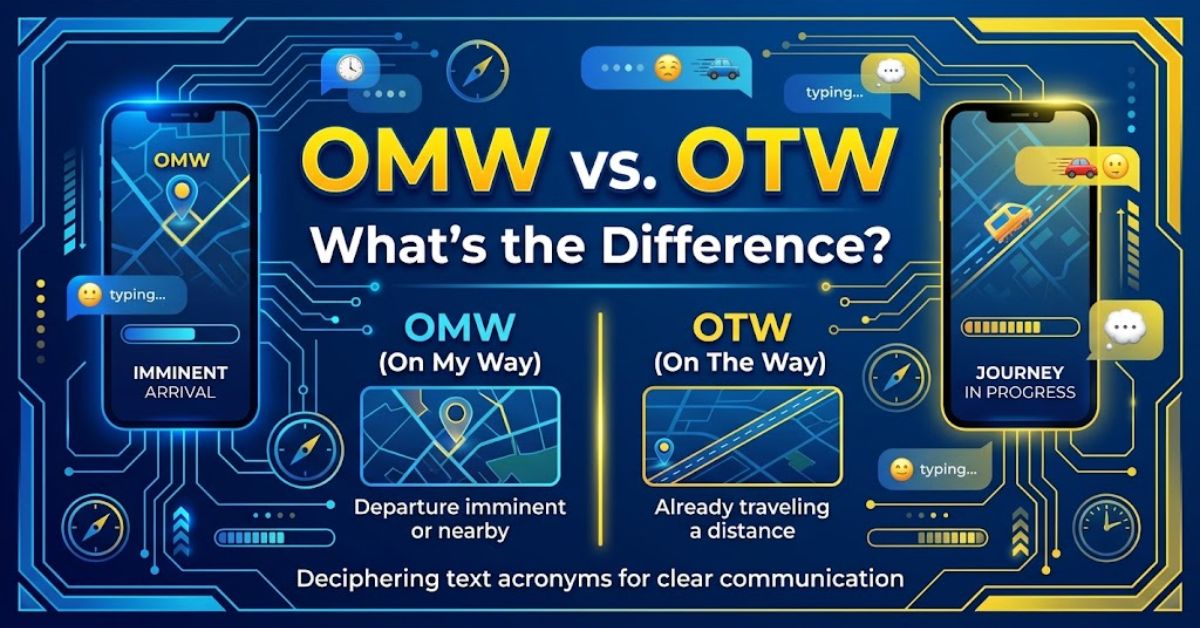
OMW means “On My Way,” while OTW means “On The Way.” Both abbreviations describe movement toward a destination, so people often use them interchangeably in casual chats.
| Term | Full form | Main idea |
|---|---|---|
| OMW | On My Way | The sender is heading somewhere |
| OTW | On The Way | Someone or something is heading somewhere |
| ETA | Estimated Time of Arrival | Expected arrival time |
| BRB | Be Right Back | The person will return shortly |
The small distinction is worth knowing.
OMW is more personal. The word “my” directly identifies the sender.
“OMW to your house.”
OTW is more general.
“The package is OTW.”
You can also use OTW for yourself:
“OTW to the gym.”
However, OMW makes the personal meaning more obvious.
OMW vs. ETA
These two terms often appear together, but they answer different questions.
OMW tells you what’s happening. ETA tells you when.
For example:
“OMW now. ETA 20 minutes.”
That’s much more useful than simply saying “OMW” when someone needs to know when you’ll arrive.
Full Form, Stands For & Short Meaning of OMW
The full form of OMW is “On My Way.”
Its short meaning is:
“I’m coming.”
Other natural interpretations include:
- I’m heading there.
- I’m on the way.
- I’m coming over.
- I’m leaving now.
- I’ll be there soon.
- I’m headed there.
The exact meaning depends on the conversation.
For example, “OMW home” means “On my way home,” while “OMW to work” means “On my way to work.”
You can write OMW in different ways:
- OMW
- omw
- Omw
Capitalization usually doesn’t change the meaning. In casual messaging, lowercase “omw” can feel especially relaxed.
Origin, History & First Known Use of OMW
OMW belongs to the broader family of digital abbreviations that became popular as texting and instant messaging grew.
Short forms became useful because people wanted to communicate quickly with limited typing. Common abbreviations such as LOL, BRB, OMG, and IDK followed the same general pattern.
However, the exact first person to use OMW in a text message is difficult to establish. Claims that identify one definite first use should therefore be treated carefully.
OMW became closely associated with mobile messaging because it communicates a complete idea using only three letters. As SMS, instant messaging, smartphones, and social platforms became everyday communication tools, abbreviations like OMW became easier to recognize.
Rather than pointing to one confirmed invention date, it’s more accurate to say that OMW developed alongside the growth of digital communication.
How People Use OMW in Daily Conversations
OMW is most useful when plans are already understood. The recipient doesn’t need a long explanation because the conversation provides the missing context.
Here are some common situations.
Meeting friends
“We’re already at the restaurant.”
“OMW!”
The sender is confirming that they’re coming.
Going home
“Dinner’s over. OMW home.”
Here, OMW communicates the person’s return trip.
Picking someone up
“Can you pick me up?”
“Sure, OMW.”
In this context, the sender is coming to the other person’s location.
Running late
“Sorry I’m late. OMW now.”
This adds reassurance because the other person knows the delay hasn’t canceled the plan.
Using it humorously
OMW can also appear in playful messages:
“OMW to the kitchen because I’m starving 😂”
Nobody expects a serious travel report here. The phrase simply adds a funny sense of movement.
OMW Meaning Across WhatsApp, Instagram, TikTok & Snapchat
The OMW meaning stays essentially the same across major social and messaging platforms. What changes is the tone and context.
| Platform | Common OMW use | Example |
|---|---|---|
| Plans and arrival updates | “OMW, 10 mins” | |
| DMs and meetup plans | “OMW to the concert” | |
| TikTok | Captions and jokes | “OMW to spend money again 😂” |
| Snapchat | Quick friend updates | “OMW 😎” |
| iMessage | Direct conversations | “OMW home” |
WhatsApp users often send OMW when coordinating plans with friends, family, or groups.
“OMW. Save me some food.”
On Instagram, OMW can appear in DMs, story replies, or casual captions.
“OMW to the beach 🌊”
TikTok
TikTok uses can be more playful or exaggerated.
“OMW to buy something I definitely don’t need 😂”
Snapchat
Snapchat messages are usually short, so OMW fits naturally into quick conversations.
“OMW 👀”
The meaning remains “On My Way.” The surrounding message determines whether it sounds serious, excited, relaxed, or humorous.
Different Meanings of OMW in Other Fields
In ordinary texting, “On My Way” is overwhelmingly the most likely meaning of OMW.
Still, abbreviations can have different meanings in specialized environments. A workplace, gaming community, organization, or technical field may assign its own meaning to the same letters.
For example, someone playing an online game might use OMW to tell teammates that they’re moving toward a specific in-game location.
Likewise, a team member could write:
“OMW to the meeting room.”
The basic idea still involves movement.
Some people may also interpret OMW as “Oh My Word” in certain contexts. That meaning is far less common in everyday texting. Context should always guide your interpretation.
If someone says:
“OMW to your house.”
There’s little reason to interpret it as anything other than “On My Way.”
Common Confusions, Mistakes & Wrong Interpretations
The biggest mistake is assuming OMW tells you exactly when someone will arrive. It doesn’t.
Here are the most common misunderstandings.
“OMW” always means they have already left
Not always. A person might use OMW when they’re about to leave, so context matters.
OMW gives an exact arrival time
It doesn’t. Use ETA when you need a time estimate.
OMW is formal English
It’s informal texting language. Use the full phrase in formal writing.
OMW and OTW are completely different
They’re very similar. OMW means “On My Way,” while OTW means “On The Way.”
OMW always means physical travel
Not necessarily. People sometimes use it jokingly or metaphorically.
For example:
“OMW to becoming a morning person.”
That doesn’t describe literal travel. It’s a playful way to describe moving toward a goal.
Similar Terms, Alternatives & Related Slang
If you want to say something similar to OMW, you have several options.
| Expression | Meaning | Best use |
|---|---|---|
| OMW | On My Way | Quick casual update |
| OTW | On The Way | Casual travel update |
| ETA | Estimated Time of Arrival | Asking or giving arrival time |
| Coming | I’m coming | Simple casual reply |
| Heading over | I’m traveling there | Natural conversation |
| Be there soon | Arrival is near | Reassuring someone |
| Leaving now | Starting the trip | Clear status update |
These expressions aren’t perfect substitutes in every situation.
For example, “ETA 10 minutes” gives timing information, while “OMW” only indicates movement.
Read More : Uhm Meaning in Text: What It Really Means in Chats, Social Media & Online Conversations (2026 Updated)
Examples of OMW in Real Chat Situations
Here are natural examples showing how people use OMW.
Example 1: Meeting a friend
Friend: Where are you?
You: OMW!
Meaning: I’m heading there.
Example 2: Giving an ETA
Friend: Are you close?
You: OMW. Should be there in 15 minutes.
Meaning: I’m coming and expect to arrive soon.
Example 3: Going home
Mom: When are you coming home?
You: OMW home.
Meaning: I’m heading home.
Example 4: Picking someone up
Friend: Can you pick me up?
You: Yep, OMW.
Meaning: I’m coming to get you.
Example 5: Casual humor
Friend: Pizza just arrived!
You: OMW 🏃
Meaning: I’m coming quickly because I want pizza.
How to Reply When Someone Says OMW
Your reply depends on what you need from the sender.
If you simply want to acknowledge the message, try:
- “Okay, see you soon!”
- “Got it.”
- “Perfect!”
- “See you soon.”
- “Drive safe!”
If you need a time estimate, ask:
“How long will you be?”
Or:
“What’s your ETA?”
If the person is running late, you can say:
“No worries. Take your time.”
The best response doesn’t need to be complicated. A short reply usually fits the same casual tone as OMW.
Is OMW Still Popular? Trends & Online Usage
Yes, OMW remains useful in 2026 because its meaning is simple and practical.
Many slang expressions come and go quickly. OMW has stronger staying power because it solves an everyday communication problem. People regularly need to tell someone they’re coming, leaving, or heading somewhere.
Its simple structure also makes it easy to understand for people who don’t regularly follow newer internet slang.
Unlike trend driven expressions that can change meaning quickly, OMW has a straightforward purpose. When someone sends it in an ordinary conversation, “On My Way” is almost always the intended meaning.
FAQs About OMW Meaning in Text
What does OMW mean in texting?
OMW usually means “On My Way.” It tells someone that you’re heading toward a destination or coming to meet them.
What does OMW stand for?
OMW stands for “On My Way.” It’s a common informal abbreviation used in digital communication.
Does OMW mean I have already left?
Not always. People sometimes use OMW when they’re about to leave, so context matters.
Is OMW formal or informal?
OMW is informal texting slang, so it’s best for casual chats rather than formal emails or official writing.
What is the difference between OMW and OTW?
OMW means “On My Way,” while OTW means “On The Way.” Both commonly describe someone heading toward a destination.
What does OMW mean on WhatsApp?
On WhatsApp, OMW normally means “On My Way.” People use it to give quick updates about travel or meetups.
What does OMW mean on Instagram?
On Instagram, OMW usually means “On My Way.” You may see it in DMs, comments, captions, or meetup conversations.
Can OMW be used at work?
You can use OMW in a relaxed team chat, but the full phrase “I’m on my way” is safer for formal workplace communication.
What does OMW home mean?
“OMW home” means “On My Way Home.” It tells someone that you’re heading back home.
What does OMW mean from a girl or guy?
The abbreviation itself doesn’t have a gender specific meaning. Whether a girl or guy sends it, OMW usually means “On My Way.”
Can OMW be used jokingly?
Yes. People sometimes use OMW humorously to describe moving toward something that isn’t a literal destination.
Is OMW the same as ETA?
No. OMW describes movement, while ETA describes expected arrival time. You can use both together when necessary.
Conclusion
OMW means “On My Way” in most texts, chats, and social media conversations. It’s a short way to tell someone that you’re heading somewhere, coming to meet them, or preparing to leave.
The abbreviation works especially well when the destination is already clear. It can appear in WhatsApp messages, Instagram DMs, Snapchat chats, group conversations, and other informal digital communication.
Just remember one important distinction: OMW doesn’t tell someone exactly when you’ll arrive. If timing matters, add an ETA.
So, when a friend texts “OMW,” you can usually take it at face value: they’re telling you they’re coming.
For clearer communication, add useful details such as “OMW, 10 minutes.” That small addition can turn a vague update into a clear one.

